Welcome!

In late 2010, having volunteered to assist Drum Barracks Civil War Museum in Wilmington, California, with research in pro-secession activity in California, director Susan Ogle handed me a list of names, places and events for possible investigation. One of those names was that of Dan Showalter, a California politician turned Confederate cavalry officer of whom I'd never heard.

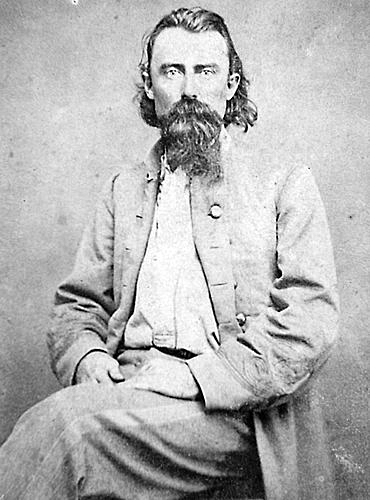
Becoming fascinated just after reading the barest outline of Showalter's life, the next year found me hunting down everything I could find about this largely forgotten character. When I had finished my research -- which included the discovery of several previously unpublished items as well as obtaining the only known photograph from a Showalter descendent -- I had so much material that Susan exclaimed, "You've got a whole exhibit right here!"

And with her guidance, on November 5, 2011, co-curated by myself and Susan Ogle, my "Dan Showalter: California's Arch Rebel" exhibit went on display at the Drum.

Now being slated for removal in August 2012 in that ongoing round of ever-successive new exhibits that mark good museums, I've started this website as a place where, over time, I can memorialize and expand upon all the material accumulated on this remarkable Californian.

Hope you'll return often as this website expands and enjoy!

Sunday, February 24, 2013

Recent contacts and new photos

One of the most exciting things about having done this research on Dan Showalter has been those folks who have contacted me "out of the blue" with new tidbits of information or, even better, previously unknown photographs of the dramatis personae in the Showalter saga. While I made the initial overtures in contacting Showalter descendent Bob Showalter which ultimately led to the finding of that wonderful, and only known, photo of Dan Showalter, these next folks I will be mentioning found me, on way of another.

An important figure in the later life of Dan Showalter is Finis Ewing Kavanaugh, the New Mexican physician, Indian fighter, territorial legislator, horse racer -- et cetera, et cetera -- who served as Showalter's second-in-command in the 4th Texas Cavalry, Arizona Brigade -- and also ended up Showalter's killer in that Mazatlan bar brawl. For what In my research, I have been hugely indebted to Fannie Kavanaugh Smith, descendant through FEK's (as we've come to address him) brother (please forgive, Fannie, if I've got the lineage wrong!) for both information and, yes, another only known photograph, this one found by her at, and published here with permission of, the University of Southern Mississippi:


Is this a fantastic old carte de visite or what? Fannie and I have recently been mulling over when this photo might have been taken. There are few clues. For one, if you look closely (remember, you can click on all of these photos and get larger views), FEK has his major's star on his collar -- but no black facing, which was the official collar for surgeons in the Confederate Army. Senior surgeons were often moved to brigade command and given additional line officer duties, which would imply this photo is from his 4th Texas Cavalry days -- but the reverse of the card implies an earlier date:


Granted, the penciled-in date is speculative by its very notation, but Kavanaugh's signature (?) is preceded by "Sr," for surgeon. Before his more active duties in 4th Texas Cavalry command, he indeed was the regimental surgeon (military records show the shift as of March 1864) -- but when would he have been in New Orleans? This may well have been following the battle at the Sabine Pass in early 1863 -- it is known he fought there as well as Showalter -- since that is right on the Texas-Louisiana border, but why, then, no black collar facing? Although it is known that uniform regulations were often more or less disregarded the farther west one went during the war. But at least as far as known postings and areas of action, the 4th Texas Cavalry, during its existence, was never really anywhere near New Orleans. So the mystery continues.

We'll save the historical discussion of FEK's interactions with Showalter until further posting(s).

Returning to the topic of folks popping up out of nowhere, I was just very recently contacted by one Gene Armistead from California. Gene is a fellow historian of California and the Southwest in the Civil War, with several publications along those lines. I can certainly recommend taking a look at his great article on the California Military Museum site about the Los Angeles Mounted Rifles, the only California militia group to go into the Confederate Army as a unit -- apparently the 3rd Texas Cavalry, Arizona Brigade! And then there's this about a truly obscure, but most interesting, topic, "Horses and Mules in the Civil War."

Gene contacted me about use of the Showalter photo for an article he is presently writing about the capture of the Showalter party in its first attempt to leave California for Texas in November 1861. I will certainly post notice of this article on this blog when it is published.

But one good turn leads to another, as they say. Gene then put me in contact with another new friend, Shirley Anne Wellman South. I provide this decorous appellation because Ms. South is the descendant of none other than Captain Chauncey Wellman -- commanding officer of the Union troops that captured Showalter and company on that late November day! As with Showalter himself and Bob's descent through his brother Elihu, Shirley is the great-great granddaughter of Capt. Wellman's brother Samuel. And with a double relation on top of that: Her antecedent Samuel and Capt. Wellman were married to sister!

Along with this new introduction came yet another previously unseen photo. Here is Capt. Chauncey Wellman in a photograph taken prior to the Civil War, when he was still a sergeant:


Ironically, at the time this photo was taken, Sergeant Wellman as posted in the Indian Territory -- where the newly formed 4th Texas Cavalry, Arizona Brigade, was first posted upon its formation.

Did these guys know how to wear uniforms or what?

I want to again thank all of these folks -- Bob, Fannie, Gene, Shirley -- both for their wonderful contributions and for their acquaintance and friendship.

Wednesday, January 30, 2013

What Really Happened at Palmito Hill

If you search for material on Dan Showalter online, you generally come away with the idea that, regardless of how he might have begun his military career, he ended up a dissolute and drunken marauder. But once you dig a bit deeper, particularly when reading Col. RIP Ford's account, sketchy as it is, of Showalter's court martial following his retreat from Palmito Hill on September 9, 1864, questions arise as to just how justifiably was Showalter brought up on charges.

In my last posting, I argued the position that, in reality, Showalter's reputation -- as well as the reputation of his 4th Texas Cavalry itself -- may have been undeservedly damaged. Even though Ford's assessment of Showalter's character later in life was qualified by saying "When not under the influence of liquor," there seem too many loose strings to draw such derogatory conclusions as to his character as have generally been drawn.

But then, the wonder of the Internet is that new material continually arises. Over the last few months -- yes, I still periodically hunt down whatever new information I can find on Ol' Dan -- I came across the tremendous find of a contemporary Texan newspaper which sheds all sorts of new light on that fateful day at Palmito Hill.


Witness the Weekly State Gazette published in Austin, Texas, on October 19, 1864 (above). Although a good chunk of the paper is missing in the bottom left corner of its front page, the article starting in the lower first column and continuing well into the third deals with "The Battles of San Martin and Palmetto Ranch (sic), Fought Sept. 9th, 1864; Extracts from the Journal of a Murrah Ranger, on the Rio Grande." That "Palmetto Ranch" is none other than the same Palmito Hill at which Col. Showalter and unit were besieged and for which he was subsequently court martialed, and the Murrah Rangers were one of the Confederate units ultimately brought up to reinforce Showalter's position after his troops had fled in retreat.

While we know that Mexican revolutionary general Cortina had opened fire on the 4th Texas Cavalry from across the Rio Grande, what we really don't know is that this cannonading came at a time -- and apparently in collusion with Union troops from a discussion in Ford's memoirs -- when Showalter's position was already under concerted attack by Union forces. To quote the article above:

Half an hour later a courier arrived from our front, from Lieut. Col. Dan E. Showalter, bringing the astonishing news that the Yankees, in strong force, with infantry, cavalry and artillery, were pressing upon his front and left; and that Cortinas (sic) was shelling him from the other side of the river.

So contrary to the impression that comes from Ford's minimal account, in addition to the cannonading, Showalter was already fully engaged with multiple Union units. And keep in mind that this would be from the landward side of his position, so already pushing Showalter's men up against the river -- only now to receive cannon fire from that direction as well!

Showalter's dispatches to Ford from this date are still available in Col. Ford's papers (see example in my August 8, 2012 posting). It is notable that the only dispatches sent to Ford have to do with Cortina's involvement and not Yankee engagement. Given this evidence of his heavy engagement, if anything one would expect that Showalter felt his unit was holding its own until this Mexican barrage began -- something that seems unlikely if he had been too drunk to exercise command, as charged later by Col. Ford under duress from Gen. Drayton.

So what then happened? Did the 4th Texas Cavalry just turn tail once the cannonading began and run? The Weekly State Gazette article continues:

Col. S. called for immediate relief. The order was immediately given for 300 men to saddle their horses, and go to his assistance. Unfortunately, however, our horses had all been out to grass, and at least two or three hours must elapse before they could be brought in.

At this point we hit the missing part of the article, but we now know that relief was unable to get to Showalter's men for a considerable amount of time.  In spite of the break in the text, Showalter's name is mentioned at the top of the second column, so we gain more information -- including this comment:

,,, 200 Yankees, in two bodies, had flanked him from the Point Isabel road and that he had with difficulty brought off his men."

So by this time we know that Showalter had been attacked literally from all sides, could not retreat other than to attempt escape in the direction of the Union lines because of the river, and that, apparently having gotten at least some distance from his trapped initial position, he was still battling some 200 enemy soldiers.

As if that's not bad enough, add this from the article:

Dispatching some messengers to inform this stampede company that we were not Yankees, we proceeded down the telegraph road in such a rain as has not fallen before since the days of Noah. The water along the prairie was up to our saddle-girths...

So now we not only have Showalter and men being completed surrounded with backs up against the river and with no way to go except into the Union lines -- we have torrential rain and, apparently, flood conditions!

The article goes on to describe how the Murrah Rangers engaged Union and Mexican soldiers for another extended period of time until, finally, troops under Col. Giddings arrive and stop the Yankee drive from Palmito Hill and behind Showalter's troops. Note that it is Col. Giddings who is cited in Ford's very sketchy memoirs of this date as having been sent to regroup Showalter's troops and stop the retreat. But now we know that Col. Giddings' success came only hours after Showalter's attempt to hold his position and after even the first arriving supporting troops, these same Murrah Rangers, had been driven back as well.

Given this evidence, the extremely difficult weather conditions, the 360-degree assault without open escape, and the several hours over which this whole scenario took place, can one really argue that Showalter was unable to exercise command? Perhaps especially if he had been drinking? Doesn't this account rather argue that Showalter was in a nearly impossible situation and made the most, only after hours of engagement, out of the very limited chance of removing his troops to safety?

I don't know much about Gen. Drayton, but now having come across this evidence I can't help but think that his ultimatum to Ford that either Showalter be court-martialed or Drayton would himself court-martial Ford reeks more of finding a scapegoat for what Drayton probably considered an embarrassment -- whether that be the "retreat" from Palmito Hill or perhaps a dislike of drinking officers. If nothing else, this speaks volumes of Ford's recounting that absolute outrage with which Showalter reacted to the charges against him.

The more information I find and the more I consider it, the more I become convinced that both Dan Showalter and his 4th Texas Cavalry, Arizona Brigade, were completely undeserving of the reputation they have come to have of being drunken desperados and marauders. On deeper examination, everything in his life speaks to Showalter's strong character and sense of principle, purpose and honor. 

We must keep in mind that such events in his life as the killing of Charles Pearcy in a duel, advocating secession from the Union, embracing the Confederacy and its slaveholding policy were at that time accepted as true and virtuous principle and honorable by not only the Southern third of the country, but by a significant number residing in the "Union states." Although we now may disavow those principles and that sense of honor, we must assess those who lived at that time by their own standards -- from which it would seem more and more that Dan Showalter and his companions in arms did not deviate.

The digital file of the newspaper cited may be found at the Texas Digital Newspaper Program of the University of North Texas.

Wednesday, August 8, 2012

In Defense of the 4th

One thing I'd like to comment on, in now expanding from the original exhibit, is the reputation Showalter's regiment has gained over time as, supposedly, renegades and marauders. The historical record is somewhat confusing over this in that there appears to have been more than one "4th Texas Cavalry," but my investigation supports the thesis that, in fact, Showalter and his regiment remained faithful and honorable soldiers in defense of Texas and the Confederacy until the very end of the war.

Following Showalter's return to command of the 4th Texas Cavalry, Arizona Brigade, after his acquittal at court-martial (another topic on which I plan to comment at a later time), the unit was ordered from the Rio Grande and Col. Ford's command to Houston via Corpus Christi. Col. Ford comments on this himself in his memoirs (Rip Ford's Texas) while also attesting to Showalter's character: "When not under the influence of liquor, he was as chivalrous a man as ever drew a sword."

Come May 19, 1865, while stationed around that city itself, the Houston Tri-Weekly Telegraph prints an adamant letter signed by Dan Showalter:


Houston Tri-Weekly Telegraph, May 19, 1865, p. 1

At a meeting held by the 4th Arizona Regt of Cavalry, Col. Showalter commanding, on Wednesday the 16th day of May, 1865, on motion, Col. Showalter was elected President, and W. C. Sevier Secretary.

Col. Showalter, on assuming the duties of the Chair, and in response to the request of the regiment, delivered an able, patriotic and eloquent speech, the sentiments of which were responded to by frequent and heartfelt applause from the men of his command, after which, on motion, the following resolutions were adopted by acclamation without a dissenting voice:

Whereas, We have recently learned with painful regret of the surrender of most, if not all, of the armies of the Confederacy east of the Mississippi river, and deeply deploring as we do the disposition now manifested by many citizens and soldiers in the Trans-Mississippi Department, to tamely submit to the re-establishment of peace, upon the degrading condition of an absolute and unconditional surrender and a consequent return to the Federal Union, with most, if not all, of our essential and cardinal rights as sovereign States ruthlessly torn from us, since the commencement of the war, by sectional and fanatical legislation on the part of Congress and the military edicts and proclamations of the President of the United States.

Therefore, be it

Resolved, That we as members of the 4th Arizona Regiment of Cavalry, composed of Californians, Texans, and Missourians, in view of the perilous condition of the country, and relying on the justice of our cause, will stand by the military to the last, in defence of our country against the brutal and tyrannical foe who, flushed with their recent successes East of the Mississippi River, now threaten this Department, and seek by one fell blow of arms, or through the cowardly submission of our soldiery, to conquer and hold us by military force, nominally as co-members of the Federal Union, but really as a subjugated Province, to be governed by military satraps, under the absolute decrees of a military dictator.

Resolved, That in view of the surrender of the troops in the Trans-Mississippi Department, we do not hold that we are bound by any stipulations which may compromise our Liberties, and that as free agents and true Southern soldiers, we will maintain our freedom at all hazards—remain in open warfare against any Yankee rule, and fight the enemy as long as life lasts—follow our commanders into the last trench—denying the right to be surrendered to the hateful foe who is now approaching our sacred threshold for the purposes of confiscation, tyranny and death.

Resolved, That this regiment will stand by and remain true to Texas and the Confederacy in the last great and final struggle for freedom against tyranny, which existing facts dictate is about to transpire upon her soil—so long as her sons evince a determination to achieve their independence or go down to honorable graves—and if forced to retire from the soil we have so long defended, we will take with us the battle flag of our Regiment, presented to us by the ladies of Texas and under its folds will if necessary cut our way through to some defensible locality, where cherishing the principles of which it is the consecrated emblem will repel the foe who dare assail us or perish in the attempt.
               
                                                                                                DAN. SHOWALTER,
                                                                                                Lt. Col. Comd’g, President.

W. C. Sevier, Secretary.

(Transcription provided by Vicki Betts, Librarian at University of Texas at Tyler)

So the question presents itself: How, in a period of two months -- other than general aspersion being thrown on Col. Showalter over his drinking and the unsustained allegation of his court-martial -- did both he and his regiment end up with the sullied reputation that has followed them down through time?

A wonderfully vivid letter has come down to us from one Thomas H. O'Callaghan, Chief Justice of San Patricio County, written to Maj. Gen. J.G. Walker complaining in strongest terms of the passing of "Showalter's Regiment" through "this place" early in their movement eastward from Brownsville, "as if a Regiment of the enemys troops and not our own, had invaded us":


Although Justice O'Callaghan complains bitterly of the plundering done by "Showalter's Regiment" ever since leaving Brownsville, a very significant mention is made beginning at the bottom of the second page:

"...about six miles from here they received orders to go to Corpus Christi -- only about one hundred and fifty obeyed this order and these men must not be held responsible in any manner for the acts of their fellows -- The balance of the Regt something over one hundred and sixty proceeded to elect one of their most desperate characters as their chief or colonel and proceed on their way towards Goliad, and I have every reason to believe in their course of plunder."

So what becomes obvious at this point is that there was a rift or mutiny by early March, when the regiment headed away from Brownsville, and it was this mutinous group, headed by "one of their most desperate characters," who was guilty of the charges Justice O'Callaghan makes. The "only about one hundred and fifty" obeying their orders to proceed to Corpus Christi would be the remainder of the unit still under Showalter's command.

This is borne out by a brief report in the Houston Tri-Weekly Telegraph of
May 10, 1865:

Houston Tri-Weekly Telegraph, May 10, 1865, p. 2, c. 1

                We are gratified to learn from Showalter’s regiment, now at Harrisburg, that nearly all those who left the regiment in the so-called “burst up,” two months ago, have come back.  A soldier of the regiment informs us that all the absentees will come in save perhaps thirty or forty who crossed the Rio Grande.  The morning reports show 318 men for duty.  Company G will be in in a day or two with 50 more.  This intelligence is very gratifying to the friends of that regiment.

(Transcription again provided by Vicki Betts.)

Note the comment there about being "gratifying to the friends of that regiment." That is not a comment that would seem warranted by a band of desperados.

A large part of the assumed malfeasance of Showalter's Regiment is the fact that another unit designated as a 4th Texas Cavalry -- not part of the Arizona Brigade -- was actively running amok in northeastern Texas in later 1864 and early 1865. This unit was so bad that, in fact, other Confederate units were sent to and did apprehend them in early 1865.

Just as further argument for vindication, the gentlemanly character of the 4th Texas Cavalry on duty under Col. Showalter is revealed in this clipping (again from Vicki Betts):

Houston Daily Telegraph, May 10, 1865, p. 2, c. 3
                                                                                                Hd. Qrs. Col. Showalter’s Regt.}
                                                                                                Near Harrisburg, May 8, 1865.}
                The members of Co. A, 4th Texas Regt. Arizona Brigade, tender their sincere thanks to the ladies of Sweet Home and vicinity for their very liberal donation of clothing to the company.
                                                                                                  H. D. E. Wolf,
                                                                                                  2d Lt. Co. A, 4th Arizona Brigade.

I hope I've here laid out a reasoned case in defense of Showalter's Regiment, the 4th Texas Cavalry, Arizona Brigade, and for its commander, "as chivalrous a man as ever drew a sword." It will be recalled that recruiting for Showalter's unit in western Texas was difficult and time-consuming due to the low character of most men in that area. It may also be true that Showalter himself was seriously and frequently inebriated by this time. However, the documentation cited argues that at all times those remaining under Showalter's command continued to dutifully follow orders and, as the May 19, 1865, letter of defiant resistance to the invading Union Army demonstrates, serve in honorable defense of their fellow Confederate Texans.


Tuesday, August 7, 2012

One more credit

Oh! And all of those military transcriptions are of the materials found in The War of the Rebellion, the tremendous compilation of all Northern and Southern   Civil War records made by the U.S. Government over several decades following the war.

Sunday, August 5, 2012

Credit where credit's due

Before going any further, I think it appropriate to give credit to the various sources for the items displayed as part of the Drum Barracks exhibit and to the various folks who were and continue to be of great help in what's turned out to be ongoing research on Dan Showalter.

First of all, again I thank Susan Ogle, Director of Drum Barracks Civil War Museum in Wilmington, California, without whom this entire project never would have come about. Not only did she introduce me to Showalter in broadening my knowledge about pro-secession California, but her assistance ran right down to completing most of the physical preparation of the exhibit itself from the materials supplied.

Next I have to thank Robert L. Showalter, the great-great nephew (if I can ever keep the "greats" in order) of Elihu Showalter, elder brother of Dan. It was Bob who had gathered all of those wonderful previously unpublished photos and letters, and it was my greatest fortune in stumbling upon his contact information in an already several-year-old posting on a Civil War discussion board online.

Vicki Betts, librarian at the University of Texas at Tyler, was also of tremendous assistance, particularly in locating old issues of the Houston Tri-Weekly Telegraph in trying to verify assertions about the later history of the 4th Texas Cavalry, Arizona Brigade (much to be said about this disputed subject later).

I have to mention Alex Vassar, the archivist at the California State Assembly. I had contacted him at the very outset of my research, thinking, well, sure, Dan's old political haunt should have some material on him. As it turned out, they had almost nothing. This struck me as sad, so months later, after I had accumulated so much material and that great photo of Showalter, I sent digital copies of the photo and a few more significant items for keeping in the Assembly's archives. Upon receiving them, Alex told me that he had been talking to some of the officials up there in Sacramento -- and I am proud to relate that not only are these items now on file in both the Assembly archives and the California State Library, but that an enlargement of the Showalter photograph now hangs on one of the Library walls. So perhaps this most humbling of consequences of my research is that old Dan has returned at last to Sacramento.

Besides the unpublished material from Bob Showalter and the Showalter family, the full newspaper photos are from issues in my own collection. The large Texas map is a reproduction readily available for purchase. The photos of the various California period newspaper clippings are from the California Digital Newspaper Collection at the University of California, Riverside (http://cdnc.ucr.edu/cdnc), a great site. The various letters reproduced here came from Fold3 (http://www.fold3.com/), another incredible site. Various other photographs were largely found online in general image searches.

A smaller exhibit taken from the larger Drum Barracks production was displayed on November 19 and 20, 2011, at the commemoration of the 150th anniversary of the Showalter Affair (the capture of the Showalter Party) by the Vail Ranch Restoration Association at the Little Temecula History Center in Temecula, California. Many thanks to Steve Clugston, the event coordinator, for that opportunity to further educate the general public on this little-known figure of California history. This was a memorable event as Bob Showalter actually came out from Pennsylvania to join me, as well as, over the two days and between Temecula and Drum Barracks, three other Showalter descendants.

One last word of premature thanks, premature in that discussion leading from this contact is yet to come. But many thanks go out to Fannie Kavanaugh Smith, the great-great niece (again, if I've got the "greats" right) of Showalter's second-in-command, Finis Ewing Kavanaugh. I received an initial e-mail from her out of the blue after she'd come across the article about my research in the San Bernardino Daily Bulletin (for which I also give thanks; thank you columnist Joe Blackstock!) while hunting down her forebear. The subsequent discussion we've had about Kavanaugh's own history has shed all sorts of light on the last days of the 4th Texas Cavalry and the time in Mexico (all to be revealed later).

As in all of these givings of credit, I'm sure I've omitted something or someone. Without specification, my thanks go out. If I become aware of those forgotten sources as we go along, I'll try to remember to add that mention.

Oh, and along these lines, I should state that I am not an academic researcher by trade. Therefore, I will generally not footnote things and give formal bibliographical-type information. But where I can and recall, I will try to give some minimal citation at least.


Mexico

Word of Robert E. Lee's surrender to U.S. Grant at Appomattox Courthouse came hard to Texas. On May 12-13, 1865, over a month later, what was to be the last battle of the war was fought in Texas at Palmito Ranch -- ironically, a rousing Confederate victory at the same location at which Showalter's troops had been cannonaded by Cortina's revolutionaries in September the year before.


On May 19, 1865, a letter promising the citizens of Texas that the 4th Texas Cavalry, Arizona Brigade, Dan Showalter commanding, would fight to the very end was printed in the Houston Tri-Weekly Telegraph. But on May 26, 1865, Gen. Kirby Smith surrendered to Union forces, ending the American Civil War.


Signaling the actual end of the American Civil War, the surrender of Texas by Gen. Edmund Kirby Smith was given ample coverage in this June 18, 1865, issue of the New York Herald.


Hundreds, ultimately thousands, of disheartened Confederates unwilling to live under Federal authority left Texas and other Confederate states. The most famous post-war exodus was that led by Gen. J.O. Shelby -- the only Confederate general refusing to surrender. Among those with him were Dan Showalter, old "Chiv" friend Justice David S. Terry, ex-Arizona Congressman Granville H. Oury, Maj. F.E. Kavanaugh, and their families.


Photograph of Gen. Joseph Orville (Jo) Shelby. Like most, Shelby returned to his home state of Missouri within just a few years of leaving for Mexico.


A group of Confederate generals photographed in Mexico in October 1865. From left to right, top to bottom, they are Generals John Magruder, William Hardeman, Cadmus Wilcox, Sterling Price and Thomas Hindman.


After arriving in Mazatlan in the summer of 1865, Showalter opened a hotel and saloon with partners. In January of 1866, while drunk in his own saloon and called to task by his bartender partner, Maj. F.E. Kavanaugh from 4th Texas Cavalry days, Showalter was shot in the arm. Ten days later, on February 4, 1866, he died of infection from the wound and was buried in the "foreign cemetery" in Mazatlan.


The Daily Alta California of November 19, 1865, reports on the establishment of Showalter's Mazatlan hotel.


The account of the bar fight leading to Dan Showalter's death in the Daily Alta California of February 25, 1866.


At some unknown date in later years, unrecorded family members placed a memorial stone to Lt. Col. Dan Showalter, 1831-1866, in the cemetery at the Jefferson Davis House in Beauvoir, Mississippi.


*****
And at this point, the exhibit "Dan Showalter: California's Arch Rebel" as it appeared at Drum Barracks Civil War Museum in Wilmington, California, is concluded.

"We propose to take one hundred chosen men under the command of Lieut. Col. Dan Showalter"...

The idea of retaking the former Territory of Arizona for the Confederacy and then continuing on to pro-secessionist Southern California held great importance for many throughout the Civil War, not the least because of the allure of the open Port of Los Angeles.


This letter of February 14, 1864, written to General Edmund Kirby Smith, the Confederate general in charge of the western front, advocated an army be formed for that purpose under the command of Dan Showalter.


In addition to the signatures of Dan Showalter and others are those of Granville H. Oury, who had been the representative of the Territory of Arizona to the Confederate Congress, and Showalter's second-in-command, Major F.E. Kavanaugh.


Although still nearly a year and a half before the end of the war in Texas, no further attempts were made by the Confederacy to reach the Pacific.


Photograph of Granville H. Oury.